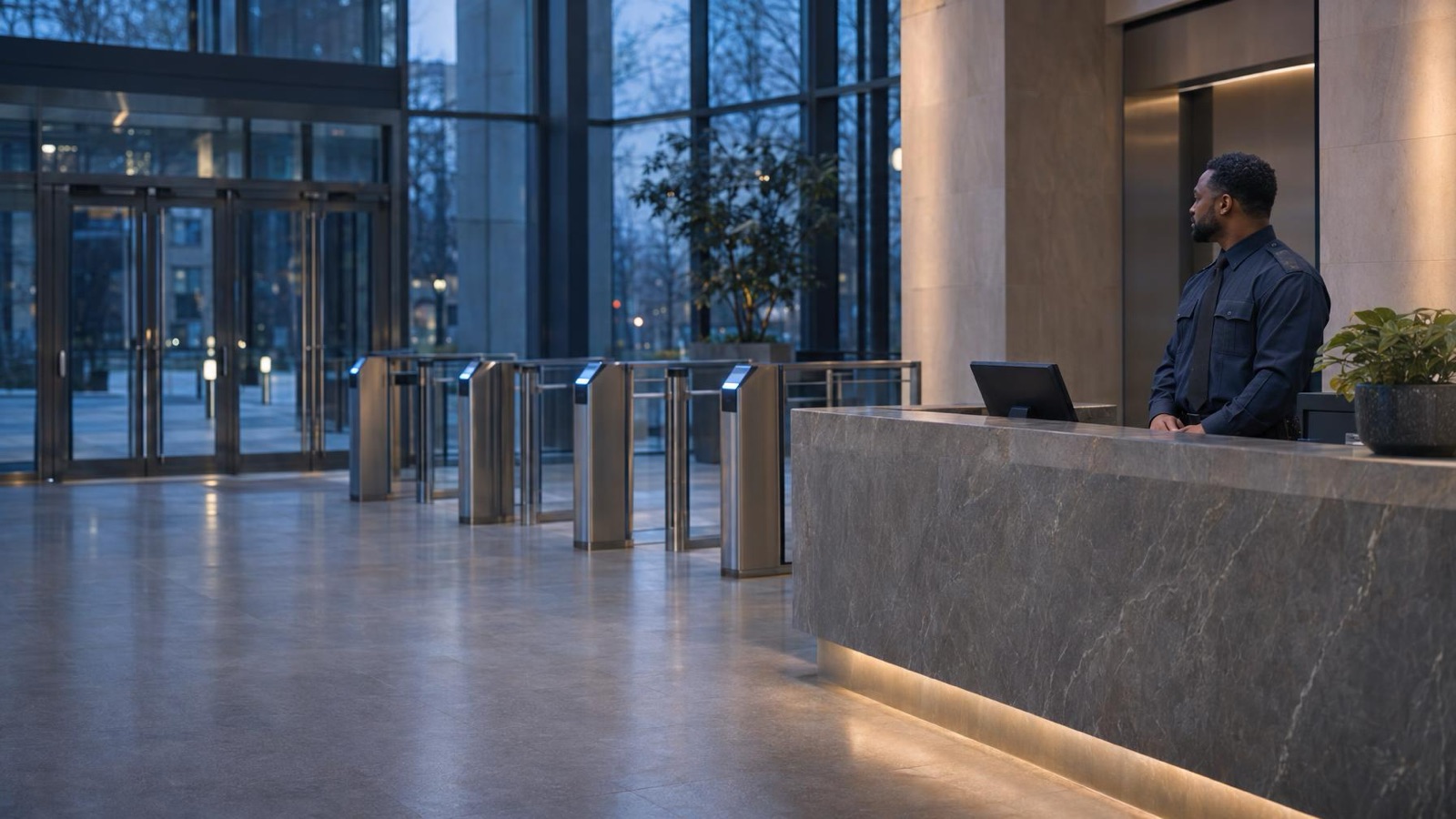
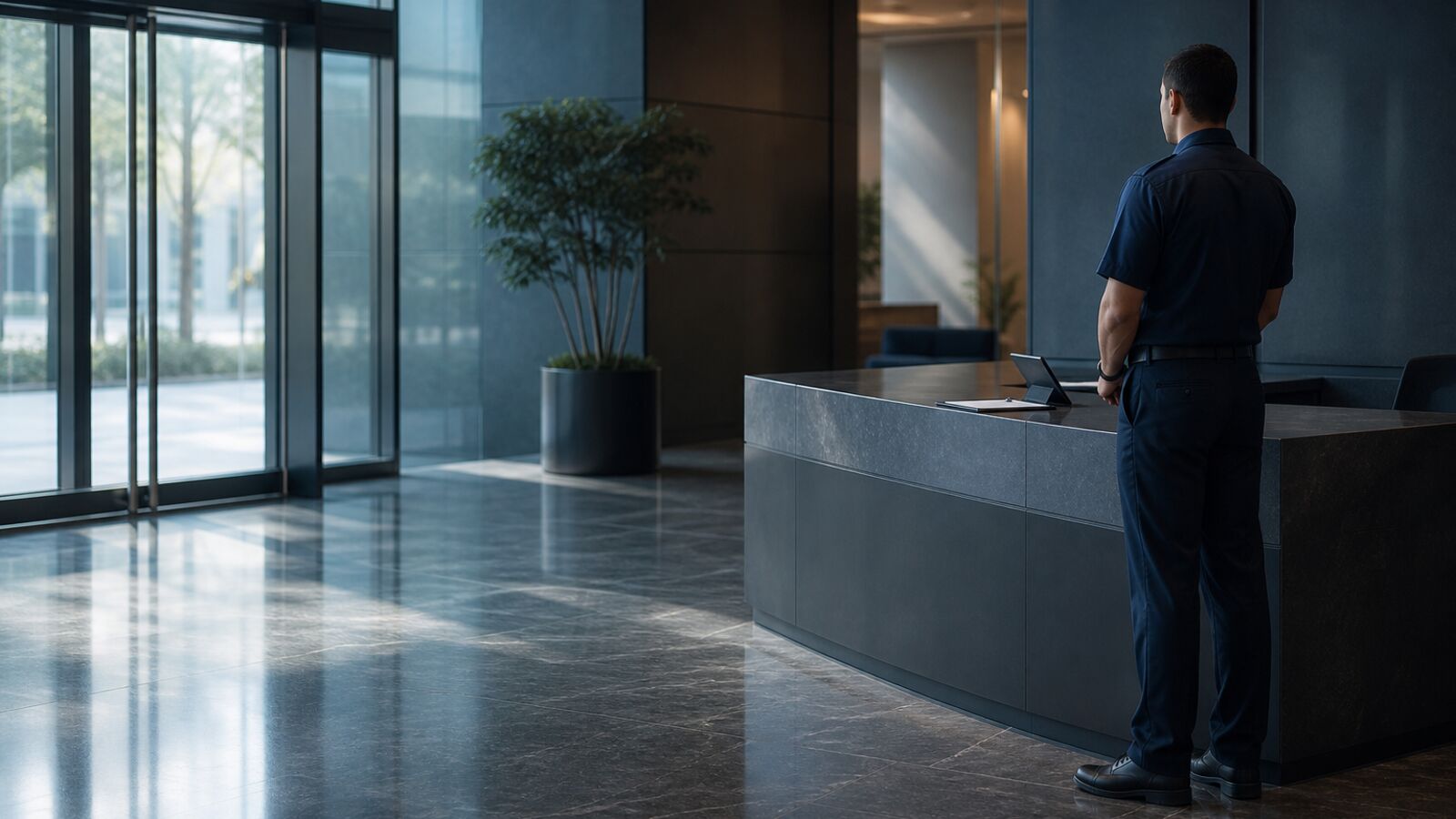
An HOA or apartment complex doesn’t need a security guard on site around the clock just to be secure. A mobile patrol, with a guard who drives in several times a night at varied times, suits a community whose problems are occasional. An on-site guard fits staffed gates, large properties, and repeated crime or trouble in the common areas. A community can also use both: a gate guard at night and patrol visits for the rest.
Does an HOA or apartment complex need a security guard?
We found no general law that requires an HOA or an apartment complex to hire a security guard. A community needs one when its own record of crime, its size or its gate makes the risk real. Some courts have held that owners must take reasonable steps against foreseeable crime, and in California a duty to hire guards takes a high degree of foreseeability.
The legal background, in short (this isn’t legal advice, so ask the association’s or the owner’s attorney about your state):
- A landlord is “no insurer” but “no bystander.” In 1970 a federal appeals court in Washington, D.C., held that a landlord has a duty to take steps to protect tenants from foreseeable crime by third parties: measures “which can reasonably be expected to mitigate the risk of intruders.”1
- An association can be the landlord. The California Supreme Court held in 1986 that a condominium association “may properly be held to a landlord’s standard of care as to the common areas under its control.”2
- Guards need a strong reason. In 1993 the same court held that “a high degree of foreseeability is required” before a landlord’s duty includes hiring security guards, and that this “rarely, if ever, can be proven in the absence of prior similar incidents of violent crime on the landowner’s premises.”3
- Florida sets a checklist without guards. Since 2023, an owner of a Florida multifamily property with at least five units who substantially implements a set of measures gets a presumption against liability for crimes by third parties. The measures are cameras at entrances and exits, lighting, deadbolts, window locks, locked pool gates, peepholes, a crime prevention through environmental design (CPTED) assessment no more than three years old, and crime-deterrence training for employees. Security guards and patrols aren’t on the list.4
So the question is practical: what is happening on the property, when, and what would stop it?
Residential security guard vs mobile patrol: what’s the difference?
An on-site security guard stays at your community for a whole shift, usually at the gate, the front desk or on foot through the common areas. A mobile patrol is a guard in a vehicle who visits your property, and often others nearby, several times a night, checks it and logs each visit. A guard is constant; a patrol is periodic.
| On-site security guard | Mobile patrol | Cameras, lighting and access control | |
|---|---|---|---|
| What you get | A guard at your community for the whole shift | A guard who visits several times a night and logs each visit | Video, lit common areas, locked gates and doors |
| Gate control | Yes: checks residents, guests, contractors and deliveries | Only during a visit | Gate codes or fobs, with no one to judge exceptions |
| Response | On site when something happens | Can be sent between visits, depending on the contract | Someone still has to watch the footage and respond |
| Cost | You pay for every hour of every shift | You pay for visits, shared with the patrol’s other stops | Mostly upfront equipment, plus any monitoring fee |
| Main gap | One guard can’t see every building, garage and pool at once | The gaps between visits | Records what happens; doesn’t stop it on its own |
| Usually fits | Gated communities, large complexes, high-rises, repeated common-area crime | Smaller or quieter communities, parking lots, overnight checks of amenities | Every community, as the base the other two build on |
The independent evidence is thin and comes from settings close to a community’s. Ronald V. Clarke’s Problem-Oriented Policing guide for the Department of Justice reports that the largest study of theft in parking facilities found “the most important preventive factor was the presence of attendants,” and that patrols work best when they are “frequent but random.”5 A companion guide by Deborah Lamm Weisel says gated communities, where “security guards are supplemented by alarms and video surveillance,” “enhance feelings of safety and produce modest crime reduction benefits.”6
When is a security patrol enough for an HOA or apartment complex?
A mobile patrol can be enough when a community has occasional problems, such as car break-ins, loitering at the pool or parking violations, rather than constant ones, and when no one needs to control a gate. Random visits at night make the property harder to predict, and the patrol’s logs show the board or manager what it found.
A patrol tends to fit when:
- Problems are occasional and mostly at night: car break-ins, trespassers in the amenities, noise or loitering after hours.
- There’s no staffed gate or front desk to cover.
- The property is small or spread out, so a guard would spend most of a shift where nothing happens.
- You need parking enforcement: checking for vehicles without permits and reporting them for towing under your rules.
- The budget won’t stretch to every hour of a night shift.
The evidence on patrols is thin but positive. The DOJ parking guide notes that “very little research has been done on the value of dedicated patrols, though two studies support their value”; in one, thefts from cars in a Portland, Oregon, district fell “from about 900 per year to about 300 per year” after an effort centered on coordinating the patrols of the area’s security firms.5 The same guide says patrols are expensive and “may be feasible only for a large facility or group of facilities.”5
Ask the patrol company how many visits you’ll get, at what hours, how long each lasts, and whether it can send the guard between visits when a resident calls.
When does a community need an on-site security guard?
A community needs an on-site security guard when someone has to be there all the time: a staffed gate, a front desk in a high-rise, a garage or common area with repeated crime, or a period of higher risk such as a string of break-ins. A guard who stays is there to prevent trouble, not just record it afterwards.
An on-site guard tends to fit when:
- You have a gate or lobby to staff, where someone has to check guests, contractors and deliveries.
- Crime keeps coming back to the same garages, mailrooms or buildings, or residents have been hurt.
- The property is large, with many buildings, garages and amenities, so patrol visits would leave long gaps.
- Something temporary raises the risk: a run of break-ins, a vacant building, construction in the community, or a large event at the clubhouse.
You can mix the two: a guard at the gate during the evening and night, and patrol visits to the rest of the property or to the hours the guard isn’t on. For a residential post, start by asking whether you need a firearm at all; armed vs unarmed security guards explains when one makes sense.
What can an HOA or apartment security guard do, and not do?
A security guard watches, deters, controls who comes in, enforces your community’s rules on its property and reports what happens. A guard isn’t a police officer. California’s guard training manual, for example, tells guards that before an incident their role is prevention, and during or after one it is to observe, report and notify law enforcement.7
The same manual is direct about the limits. Guards don’t have “the same powers as peace officers, according to the law,” and anyone who pretends or implies they are a peace officer “is committing a crime.”7 It says a guard’s area of responsibility doesn’t include “motor vehicle traffic violations.”7 California also bars licensees from using a title, insignia or statement that could suggest a connection with a government agency.8 Outside California, check your state’s regulator.
What residents can expect from the guard belongs in the post orders you agree with the security company:
- Gate and guest control: who gets in, how guests and contractors are checked, and what happens when a name isn’t on the list.
- Patrols: the route through garages, pools, mailrooms and parking lots, at varied times.
- Rules: parking, amenity hours and noise, and how a guard reports a violation to the manager or board rather than enforcing it by force.
- Calls: who to call for a break-in, a fire, a medical emergency or a domestic dispute, and in what order.
- Reports: a daily activity report, and how incidents reach the manager or the board.
How much does HOA or apartment security cost?
The cost of HOA or apartment security depends mostly on hours. An on-site guard is paid for every hour of every shift, so covering only nights costs far less than 24/7. A mobile patrol can cost less than a guard for the same nights, because you pay for visits rather than every hour of the shift. Location, guard type and the contract term move the price too.
Some arithmetic helps:
- Nights only (10 p.m. to 6 a.m., seven nights) is 56 guard-hours a week.
- 24/7 is 168 guard-hours a week, which is more than four full-time guards on a 40-hour week before anyone takes a day off.
- A patrol is on your property only during its visits; the company spreads the rest of the guard’s night across its other stops.
For context, security guards earned a national median hourly wage of $18.28 in May 2025.9 That is the guard’s pay, not what a security company charges. In its 1993 decision, the California Supreme Court also noted that “the monetary costs of security guards is not insignificant.”3
What moves the price:
- Hours and days: nights only, nights and weekends, or 24/7, and for how many months.
- Guard or patrol: a patrol shares a guard’s time across several sites.
- Armed or unarmed: armed guards need extra licensing in states that license guards; in Texas, for example, a guard who carries a firearm needs a security officer commission.10
- Number of posts: a gate plus a roving guard is two posts.
- Contract term: a contract for months or years is priced differently from a few weeks of cover after a break-in.
For why a company charges more than it pays the guard, monthly costs and how to read a quote, see how much does a security guard cost.
How to hire a security patrol company for an HOA or apartment complex
Hire a security company that is licensed in your state, carries liability insurance, can staff the posts and hours you need, and will write post orders for your community. In the four states below, the company needs a license to provide guards or patrols, and each guard needs their own. Check both with your state’s regulator before the board signs.
| State | Regulator | Security or patrol company needs | Each guard needs |
|---|---|---|---|
| California | Bureau of Security and Investigative Services | A private patrol operator license, with commercial general liability insurance of at least $1,000,0001112 | A security guard registration12 |
| Texas | Department of Public Safety | A security services contractor license to act as a guard company, which covers “street patrol service” (sections 1702.102, 1702.108)10 | A noncommissioned security officer license, or a commission to carry a firearm10 |
| Florida | Department of Agriculture and Consumer Services | A Class “B” security agency license13 | A Class “D” security officer license13 |
| New York | Department of State | A watch, guard or patrol agency license14 | Security guard registration15 |
In California, you can look up the company and its guards on the state’s license search.
Boards have their own rules for contracts. In Florida, for example, an HOA’s service contracts must be in writing, and a contract that costs more than 10% of the association’s total annual budget, including reserves, needs competitive bids; the board doesn’t have to accept the lowest bid.16 Florida condominium associations have the same rule at 5%.17 Check your state’s rules and your governing documents.
Before you sign, ask the company for:
- Its license number and the license or registration of each guard on your property.
- A certificate of insurance with the coverage, limits and current dates, and whether the association can be named on it.
- Draft post orders for your community: gate rules, patrol routes, parking rules and who to call.
- A sample daily activity or patrol report, and how the manager or board receives it.
- For a patrol: the number of visits a night, how they’re timed, and how fast it can send a guard when called.
- Who supervises the guards at night, and how a no-show is covered.
- The contract terms: notice period, minimum term, and how hours can change.
For more on checking a company, see 8 questions to ask before hiring a security guard company.
What to have ready before you ask for a quote
Before you contact security companies, write down the address and the number of units, the gates, garages and amenities, the hours and days you want covered, what’s been happening and when, and whether you want an on-site guard, a patrol or both. Companies can then price the same job, and you can compare quotes line by line.
Whether you contact companies yourself or request residential security guards through Bannerman, the guarding company that covers your area confirms the price after reviewing the job. Revisit the plan every few months: what a community needs after a run of break-ins is rarely what it needs a year later.
FAQ
Do HOAs have security?
Some do, with a staffed gate, a mobile patrol or both; others rely on lighting, locks, cameras and the police. We found no national count of how many have security. There were about 373,000 community associations in the US in 2025, home to 78.1 million residents,18 and what each one has depends on its budget, its governing documents and what’s happening on the property.
Can HOA security pull you over or stop your car?
Not the way police can. Security guards aren’t police officers, and California’s guard training manual says enforcing motor vehicle traffic violations isn’t part of a guard’s job.7 A guard may enforce the community’s own parking and gate rules on its property, as set out in the post orders, and report problems to the manager or the police.
What are a landlord’s responsibilities for tenant safety and security?
Some courts have held, starting with a 1970 federal appeals decision in Washington, D.C., that landlords must take reasonable steps to protect tenants from foreseeable crime in the areas they control,1 but a landlord is “no insurer” of tenants’ safety.1 What that requires varies by state and by the property’s history; in California, a duty to hire guards takes a high degree of foreseeability.3 Ask an attorney in your state.
What is mobile patrol security?
Mobile patrol security is a guard who drives to an apartment complex or HOA several times a night at varied times, checks gates, garages, pools, laundry rooms and parking lots, looks for open doors, damage and trespassers, enforces parking rules if the contract says so, and logs each visit. Between visits, the guard may be covering other properties on the route.
Is a security guard or a patrol better for a gated community?
A gate that has to be staffed needs an on-site guard during the hours it’s staffed. A gated community can add patrol visits for the rest of the property, or for the hours the gate is unstaffed and residents use codes or fobs.
Sources
-
Kline v. 1500 Massachusetts Avenue Apartment Corp., 439 F.2d 477 (D.C. Cir. 1970), Public.Resource.Org, https://law.resource.org/pub/us/case/reporter/F2/439/439.F2d.477.23401_1.html, accessed 2026-11-19 ↩ ↩2 ↩3
-
Frances T. v. Village Green Owners Assn., 42 Cal.3d 490 (1986), Stanford Law School, Supreme Court of California Resources, https://scocal.stanford.edu/opinion/frances-t-v-village-green-owners-assn-28425, accessed 2026-11-19 ↩
-
Ann M. v. Pacific Plaza Shopping Center, 6 Cal.4th 666 (1993), Stanford Law School, Supreme Court of California Resources, https://scocal.stanford.edu/opinion/ann-m-v-pacific-plaza-shopping-center-31563, accessed 2026-11-19 ↩ ↩2 ↩3
-
The Florida Senate, “Florida Statutes 768.0706, Multifamily residential property safety and security; presumption against liability” (2026), https://www.flsenate.gov/Laws/Statutes/2026/768.0706, accessed 2026-11-19 ↩
-
Ronald V. Clarke, “Thefts of and From Cars in Parking Facilities”, Problem-Oriented Guides for Police No. 10 (U.S. Department of Justice, Office of Community Oriented Policing Services; updated April 2010), https://popcenter.asu.edu/sites/g/files/litvpz3631/files/theft_of_and_from_cars_in_parking_facilities.pdf, accessed 2026-11-19 ↩ ↩2 ↩3
-
Deborah Lamm Weisel, “Burglary of Single-Family Houses”, Problem-Oriented Guides for Police No. 18 (U.S. Department of Justice, Office of Community Oriented Policing Services, 2004), https://popcenter.asu.edu/sites/g/files/litvpz3631/files/burglary_of_single-family_houses.pdf, accessed 2026-11-19 ↩
-
California Bureau of Security and Investigative Services, “Powers to Arrest and Appropriate Use of Force Training Manual” (July 2023), https://www.bsis.ca.gov/forms_pubs/poa.pdf, accessed 2026-11-19 ↩ ↩2 ↩3 ↩4
-
California Bureau of Security and Investigative Services, “Bureau Badge, Patch and Cap Insignia Review Process”, https://www.bsis.ca.gov/industries/app_bpci.shtml, accessed 2026-11-19 ↩
-
U.S. Bureau of Labor Statistics, “OEWS data series OEUN000000000000033903208 (Security Guards, national median hourly wage)”, https://api.bls.gov/publicAPI/v1/timeseries/data/OEUN000000000000033903208, accessed 2026-11-19 ↩
-
Texas Legislature, “Occupations Code, Chapter 1702. Private Security” (sections 1702.102, 1702.108, 1702.161, 1702.221 and 1702.222), https://tcss.legis.texas.gov/resources/OC/htm/OC.1702.htm, accessed 2026-11-19 ↩ ↩2 ↩3
-
California Bureau of Security and Investigative Services, “Private Patrol Operator FAQs”, https://www.bsis.ca.gov/consumers/faqs/ppo.shtml, accessed 2026-11-19 ↩
-
California Bureau of Security and Investigative Services, “Security Guard Registration”, https://www.bsis.ca.gov/forms_pubs/guard_fact.shtml, accessed 2026-11-19 ↩ ↩2
-
The Florida Senate, “Florida Statutes 493.6301, Classes of licenses” and “493.6101, Definitions” (2026), https://www.flsenate.gov/Laws/Statutes/2026/493.6301 and https://www.flsenate.gov/Laws/Statutes/2026/493.6101, accessed 2026-11-19 ↩ ↩2
-
New York Department of State, “Watch, Guard or Patrol Agency”, https://dos.ny.gov/watch-guard-or-patrol-agency, accessed 2026-11-19 ↩
-
New York Department of State, “Private Investigators, Bail Enforcement Agents, Watch, Guard or Patrol Agencies and Security Guards Licensing Law”, https://dos.ny.gov/pi-bail-enforcement-watch-guard-or-patrol-security-guard-law-0, accessed 2026-11-19 ↩
-
The Florida Senate, “Florida Statutes 720.3055, Contracts for products and services; in writing; bids; exceptions” (2026), https://www.flsenate.gov/Laws/Statutes/2026/720.3055, accessed 2026-11-19 ↩
-
The Florida Senate, “Florida Statutes 718.3026, Contracts for products and services; in writing; bids; exceptions” (2026), https://www.flsenate.gov/Laws/Statutes/2026/718.3026, accessed 2026-11-19 ↩
-
Foundation for Community Association Research, “2025 U.S. National and State Statistical Review”, https://foundation.caionline.org/wp-content/uploads/2026/03/2025StatisticalReviewFoundation.pdf, accessed 2026-11-19 ↩
Written and reviewed by the Bannerman team.